
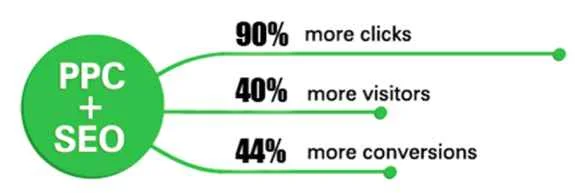
SEO and PPC work together
Too many people think of “search” as a big bucket for digital marketing. Search engine optimization (SEO) and pay-per-click (PPC) marketing both have to do with search engine results pages (SERPs), so they can be grouped and treated the same way. Law? It seems rational.
But here’s the thing: that assumption is entirely incorrect.
SEO and PPC impact the search results users see, but they are two very different strategies and should be treated differently. I want to take a few minutes to discuss the differences between these two tactics, how they influence each other, and how they can work together effectively. And, since we’re explicitly discussing search, we’ll only focus on paid search ads when referring to PPC for more succinct comparisons.
The main differences between SEO and PPC
Along with the basic definitions of each of these tactics – SEO impacting organic listings on a SERP and PPC driving paid listings –, there are four key differences why these two need to be addressed separately.
Impact on the marketing funnel
SEO takes into account the entire marketing funnel. If your site has quality content that serves as an excellent introduction to new users at the top of the funnel, you target those pages to get them to rank more often for relevant search queries. Likewise, you’re also addressing hub pages or category pages that impact mid-funnel users and pages designed to get low-funnel users to convert.
On the other hand, PPC is mostly for low-funnel users who are more ready to convert and generate value. If you’re going to spend money getting users to click through to your site, you don’t want to waste that investment on search queries or users who are less likely to buy from you. Ensuring PPC is done cost-effectively means leveraging the bottom of the funnel.
Landing Page Environments
SEO strategies usually encapsulate (almost) an entire website. Tactics can impact the architecture of a website and influence content on hundreds or thousands of pages. Each page, its components, and its relationship to other pages have the potential to impact organic search visibility and ranking. Therefore, these are factors that an SEO strategist must take into consideration. The screenshot below shows Portent’s organic landing page for PPC management services.
Screenshot of Portent’s organic landing page for PPC management services
On the other hand, PPC strategies focus on more confined landing page environments and typically use less on-site content. If a paid search strategist’s goal is to get users to click on an ad and convert, narrowing a user’s path to generating a conversion by removing distractions makes sense. Obstacles and opportunities to move away from the conversion funnel. Unlike the organic landing page featured above, the image below shows a custom landing page created for a PPC campaign promoting our technical SEO ebook. It has more focused content, fewer distractions, and a clear call to action to download the PDF.
Screenshot of a custom landing page for a specific paid campaign promoting Portent’s technical SEO guide.
The importance of links
To some degree, organic rankings and impressions depend on the strength of a website’s backlink profile. The number of domains linking to a particular page and the authority significantly impact SEO.
PPC is unaffected by links and backlink profiles. Advertisers can control which landing page URL is used for a given ad, regardless of its organic “strong.” A common tactic for many PPC accounts is to use landing pages hosted on a subdomain or separate part of the main website, which is not indexed or crawled by search engines. These pages can be lighter on content to narrow the user’s attention and not compete with other pages in the main domain, containing more reliable information.
Appearance on the SERP
SEO strategists can make tactical changes like adjusting title tags to influence what’s displayed on an organic listing. However, to some extent, an SEO strategist cannot control precisely what is displayed on a SERP (e.g., site links).
Screenshot of the SERP for “signal” with a box drawn around the site links automatically generated by Google.
While Google or Bing can test different SERP layouts and the amount of text ads displayed (e.g., one or both lines of description), a PPC strategist has more direct control over what is displayed on a SERP. When an ad generates an impression, even when adding extensions that display alongside a text ad, advertisers dictate what content is used or likely to be displayed.
How SEO and PPC influence each other
Now that you understand some of the key differences between SEO and PPC let’s discuss how they can impact each other. After all, since both areas affect search results, there’s bound to be a natural interplay between the two.
When it comes to their business strategy, a user is more likely to click through to your site if multiple opportunities exist on a SERP. This is a logical consequence of taking up more space on a SERP with multiple listings. When an organic listing and a paid listing appear in response to a user’s search query, your business has more potential to benefit from that action. So from a business perspective, that’s a good thing. However, traffic and conversion metrics can be affected differently when looking at SEO or PPC results in a vacuum.
SEO and PPC influence each other
Over the past year, Google has made paid ads more visible at the top of the SERPs on all devices. This translated into an increased volume of paid search impressions and clicks (as well as increased revenue for Google). And because organic listings have been lowered on the SERPs, the volume of traffic from organic search has gone down in some cases.
By focusing on these trends independently, you might conclude that “SEO is doing badly” when it might be perfect. That’s not to say that this search marketing trend is good or bad; it’s just essential for you to understand that this trend can cause PPC and SEO metrics to affect each other.
An SEO strategist also looks for opportunities to improve on-site usage metrics such as site speed, average time on page, and bounce rate. Improving these metrics improves organic search rankings, but it also benefits paid search campaigns. Google takes these elements into account when assigning quality scores (e.g., landing page experience), which can, in turn, improve impression and click volume to levels of fixed costs. This shows that SEO tactics can also impact PPC performance.
How SEO and PPC can work effectively together
You understand how SEO and PPC are different from each other and what effects they can have on each other. Here’s the most important question you can ask yourself: how can they work together in a cohesive digital marketing strategy?
Any website will usually have a set of category or hub pages. These are used to logically, and user-friendly organize pages and content. Some of these pages will most likely perform better or be more visible in organic search results than others. Identifying which category pages are performing well can inform your PPC strategy on which search campaigns you should include in your paid search strategy.
Additionally, the organic strength and on-site success of pages in a given hub or category can also build retargeting audiences. That PPC advertisers can use in their search campaigns. You can bid higher only to users who are still searching for relevant terms in hopes. That you will generate an ad impression at the top of the SERP and get them to click and convert.
SEO and PPC can work together
The organic strength of specific search terms can also influence which paid search campaigns get the most budget. For example, if an expensive and competitive campaign is struggling to deliver results in your PPC account. But the SEO traffic for those terms is high, a PPC strategist could divert dollars to other campaigns, providing better results. Conversion measures. Ultimately, SEO and PPC strategies work together to produce more potential overall conversions for the business.
Finally, paid search accounts have access to search query reports that can inform your SEO keyword strategy. This PPC reports shows what users are searching for and how strong click-through rates are for those particular terms. This can help drive your entire on-site content strategy. Allowing you to create or update pages that match the most relevant and essential search query trends.
What you can do next
Do you still treat SEO and PPC as the same thing? It is not because “they are both on a quest” that they are working in the same direction. Look at your key performance indicators for each area and measure them against what each should achieve. Make sure you have a solid strategy for each that is both suited to its corresponding objective and compatible with the other.

2 thoughts on “HOW SEO AND PPC WORK TOGETHER”
Id like to thank you for the efforts youve put in writing this blog. I am hoping to check out the same high-grade content by you later on as well. In truth, your creative writing abilities has motivated me to get my own, personal website now 😉
Hello! I simply wish to give you a big thumbs up for the excellent info you have right here on this post. I will be coming back to your web site for more soon.